
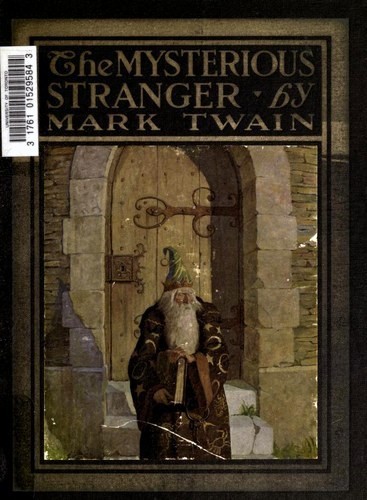
Buy on Amazon and support us at no extra cost
The Mysterious Stranger
Description
IT WAS IN 1590-winter. IN compliance with the request of a friend of mine, who wrote me from the East, I called on good-natured, garrulous old Simon Wheeler, and inquired after my friend's friend, Leonidas W. Smiley, as requested to do, and I hereunto app...
AI Woke Analysis
Mark Twain's "The Mysterious Stranger," published posthumously in 1916, is a philosophical fantasy novella set in the isolated Austrian village of Eseldorf in 1590, where three young boys encounter a supernatural being named Satan, nephew of the biblical figure and an immortal angel devoid of sin.13 Narrated by Theodor Fischer, the story unfolds amid medieval superstition, witch hunts, and religious fervor, as Satan demonstrates godlike powers—creating illusions, miniature worlds, and riches—while casually destroying lives and revealing harsh truths about existence. He saves the gentle priest Father Peter from ruin, only to drive him mad for illusory happiness, and alters fates to shorten suffering through death, all while mocking human pettiness during visions of history, heaven, and hell. The narrative builds to a nihilistic climax where Satan declares the universe an empty dream conjured by Theodor's mind alone, dissolving all reality into solipsistic void.2
The work's core themes—human inferiority, the illusion of reality, the folly of the "Moral Sense" that breeds cruelty, religious hypocrisy, and cosmic indifference—dominate without any intrusion of progressive political messaging or social justice advocacy.4 Twain skewers the Church's fear-mongering, mob mentality in persecutions, and humanity's self-deceptive vanities, portraying villagers as uniformly flawed Europeans trapped in ignorance, with no exploration of race, gender dynamics, identity categories, or calls for diversity and inclusion. Brief nods to exploitation, like factory owners starving workers, serve as examples of universal evil rather than indictments demanding equity or reform; animals, by contrast, embody innocence free of moral hypocrisy. Satan's detached amusement at human "progress"—endless wars and tyrannies—prioritizes existential satire over storytelling, yet the philosophical inquiry propels the narrative, unburdened by identity politics.1
Lacking modern "woke" elements entirely, the novella reflects Twain's late-life pessimism, critiquing all humanity impartially from an early 20th-century lens, with no prioritization of marginalized voices or inclusionary agendas. Its tone of dark irony and wonder remains timelessly provocative, focused on timeless flaws like superstition and determinism, earning it a rating of 1 for woke content.
Sources
AI Quality Analysis
Mark Twain's "The Mysterious Stranger," published posthumously in 1916, showcases the author's late-career mastery of philosophical fantasy through a novella-length tale of boys in a medieval Austrian village encountering a supernatural entity—Satan or "No. 44"—who dazzles with miracles and visions while unraveling harsh cosmic truths.15 The storytelling unfolds episodically, blending whimsical boyhood adventures with escalating supernatural demonstrations and global spectacles of human folly, creating an intriguing structure that builds tension through foreshadowed fates and dreamlike transports, though its pacing falters in protracted dialogues that shift from thrilling action to contemplative exposition.2
Character development centers on the enigmatic stranger as a brilliantly witty, poised figure whose casual omnipotence and ironic detachment make him one of Twain's most memorable creations, serving as a dynamic foil to the naive, archetypal boys whose arcs trace a subtle evolution from wonder to disillusionment.45 Supporting villagers provide vivid, if simplistic, contrasts through their reactions to chaos, enhancing the narrative's dramatic irony without deep individuation.
Twain's writing quality remains a highlight, with sharp, satirical prose that weaves humor, vivid imagery, and articulate philosophical exchanges into a haunting whole, demonstrating his unparalleled command of voice—even in this darker mode—despite the bitterness that occasionally renders passages didactic.3 The work's originality shines in its fusion of folkloric fantasy with metaphysical concepts like self-duality and illusory reality, pushing beyond Twain's humorous staples into experimental territory that feels fresh and provocative.1
While posthumous editing compromises cohesion—melding unfinished manuscripts into a "literary fraud" per scholars, leading to inconsistencies—the core craftsmanship endures, delivering intellectual entertainment laced with dark wit and emotional resonance that lingers, though its unrelenting gloom tempers broader appeal compared to Twain's lighter masterpieces.12 Reader consensus on platforms like Goodreads hovers around 4.1/5, affirming its status as a compelling, if flawed, gem in Twain's oeuvre.2
Sign in to rate, review, or report this content.
User Reviews
Loading reviews...
No ratings yet. Be the first to rate this media!
No keywords added yet